NFL Week 1 Betting Tips: Why Opening Weekend Rewards Patient Punters
 Available in US
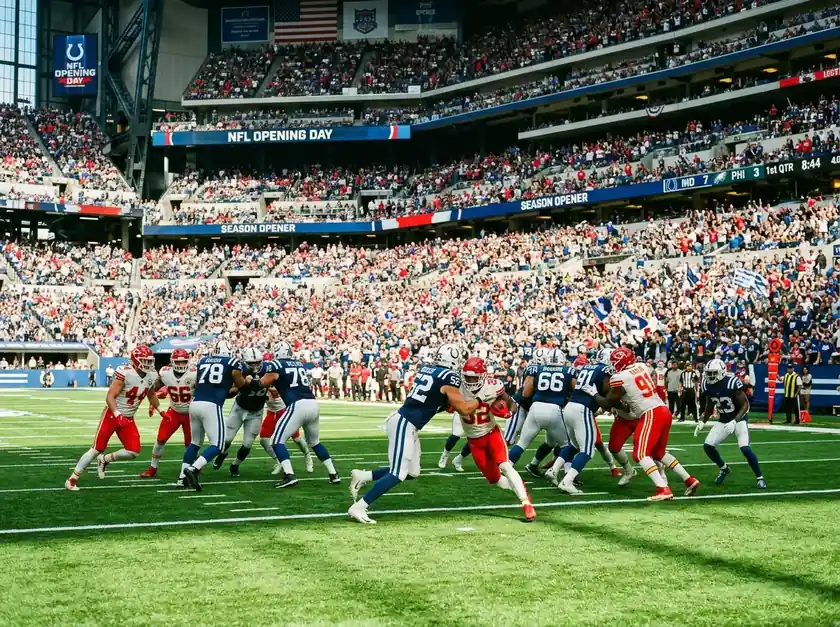
Week 1 is the week the bookmakers dread. No in-season injury history, no reliable performance data, and a public betting market that moves on narrative and preseason hype rather than actual information. In my experience, it’s also the week that produces some of the most exploitable lines of the entire season — not because the bookmakers are careless, but because the uncertainty cuts in both directions and the sharp side of that uncertainty often belongs to the patient, data-driven bettor rather than the crowd.
Why NFL Week 1 Lines Are Softer Than Mid-Season
A bookmaker setting a Week 1 NFL line is working with limited data. Preseason games tell you almost nothing about how a team’s first-choice starters will perform — coaches deliberately conceal schemes, rest key players, and use the preseason as an evaluation tool rather than a preparation exercise. Training camp reports are narratively interesting but analytically weak. The public, meanwhile, is forming opinions based on offseason signings, media projections, and the hype cycle that surrounds roster construction stories.
The result is a betting market that’s more vulnerable to overvalued narratives than at any other point in the season. A quarterback who had a great 2025 season but is now running a new offence may be priced as if that greatness carries forward automatically. A team that won 12 games last year but lost key defensive personnel in the off-season may be priced as if last year’s form is a reliable predictor. These gaps between narrative price and analytical reality are widest in Week 1 because there’s no recent on-field data to close them.
Divisional underdogs amplify this effect. Teams that know their divisional rivals intimately — having faced them twice a year, often for multiple years — are better positioned to exploit the schematic uncertainties of Week 1 than non-divisional opponents. Since 2014, divisional underdogs have covered the spread at a remarkable rate, recording a 37-15-1 ATS record across the tracking period, which equates to a 71% cover rate. That’s one of the most consistently documented trends in NFL betting data.
Divisional Underdogs in Week 1: The Numbers That Drive the Strategy
The 71% ATS cover rate for divisional underdogs in Week 1 is the headline number, but understanding why it persists is what makes it useful rather than just a statistic to follow blindly. Divisional familiarity is genuine — a defensive coordinator who has faced the same offensive scheme four times in the past two seasons has real preparation advantages over someone constructing a game plan against an unfamiliar system. In Week 1, with reduced preparation time compared to a mid-season divisional matchup, that familiarity edge is at its most acute.
The opening weeks of the season also expose another pattern worth knowing. In the first three weeks of the 2024 season, underdogs receiving five and a half or more points went 13-2 ATS — one of the strongest short-term windows in recent NFL betting data. These aren’t teams expected to win the game. They’re teams expected to keep it close enough to cover a substantial spread, and in early-season football where line-setting is imprecise and defensive scheme adaptation is limited, they do exactly that with unusual frequency.
The psychological component reinforces the data. Favourites in Week 1 often carry a conservative mindset — particularly teams with Super Bowl aspirations who are focused on avoiding injury and establishing patterns rather than dominating a single game. That conservatism shows up in play-calling, clock management, and willingness to push the lead. A team content to win 24-17 isn’t going to cover a -7 spread against a divisional opponent that’s seen their scheme before.
How UK Punters Should Approach NFL Week 1 Betting
The practical implication of all this for UK betting is straightforward but requires some discipline to execute. Restrict your Week 1 bet builder legs — Week 1 is a bad week for multi-leg combinations precisely because the uncertainty that creates line value also creates unpredictability across multiple outcomes. A two or three-leg builder built around a single game can still work, but the eight or ten-leg accumulator that might tempt you with a giant combined price should be left alone in Week 1 when the individual probability of each leg is harder to assess than usual.
Totals and props can be productive markets in Week 1 if you’ve done specific preparation. Quarterbacks running genuinely new offences — new head coach, new scheme, new coordinator — are interesting under candidates for passing yards totals in Week 1 specifically, because unfamiliar systems produce conservative early-game play-calling. Running back usage props are similarly interesting when a team has a new offensive line — the run game takes longer to establish itself under new blocking schemes, creating potential under value on rushing yards lines.
The most important discipline for Week 1 is accepting that you will miss games. You don’t need to bet every match on the opening weekend. Three or four carefully selected positions with genuine analytical rationale is far more productive than spreading stakes across ten or twelve games based on general impressions. Week 1 rewards selectivity above all else.
Building on these early-season patterns into a broader season-long framework is what the NFL value betting approach covers in detail.
The one market type in Week 1 that I consistently find worth targeting is the totals market for games involving teams with new offensive coordinators. A coordinator installing a new scheme in live conditions tends toward conservative play-calling in Week 1 — fewer deep routes, more short passes, higher proportion of run plays. The resulting scoring output frequently undershoots the bookmaker’s total line, which is set using the general offensive efficiency of the teams involved rather than accounting for the coordination friction of Week 1 implementation. That’s not a guarantee, and it’s not a mechanical rule to apply to every new coordinator situation — context matters. But it’s a specific, analytically grounded reason to evaluate the under in those games rather than defaulting to the prevailing public preference for the over.
One more angle worth flagging for Week 1: time-zone travel. West Coast teams travelling east for 1pm kickoffs are operating at a biological 10am — before many athletes would typically be at peak performance capacity. The historical data on this is mixed but directionally consistent: West Coast teams in early-window eastern road games in Week 1 perform below expectation at higher rates than schedule-adjusted probability suggests. It’s a minor edge at best, but in Week 1 where small analytical advantages matter most, minor edges aggregate into meaningful ones.
Are NFL preseason results useful for Week 1 betting?
Mostly not, but with specific exceptions. Preseason games are structured to evaluate fringe roster players rather than test first-choice starters, so headline results (wins and losses) are nearly meaningless. What can be useful is watching how a new offensive system installs in live-game conditions — specifically whether a new quarterback looks comfortable with their protection scheme and how quickly route concepts are being absorbed. These are qualitative signals, not statistical ones, and should be weighted accordingly.
Do UK bookmakers open NFL Week 1 lines early?
Most major UK bookmakers release initial Week 1 lines in the days following the previous season’s Super Bowl, with firmer prices appearing once the draft and free agency period concludes in late April and May. The most meaningful early lines come in July and August when roster construction is largely settled. Monitoring early lines is worthwhile if you’ve identified a specific narrative overvaluation — prices often shift significantly between the July opening and the Week 1 kickoff as more information enters the market.
Prepared by the nfl top Bets editorial staff.