Best NFL Bets Today UK: A Same-Day Checklist Before You Place Any Wager
 Available in US
The worst NFL bet I ever placed was one I’d already decided to make on Wednesday, hadn’t revisited by Friday, and placed on Saturday morning without checking anything new. The team’s starting quarterback had been downgraded to doubtful on Thursday. The line had moved two points. I hadn’t noticed either. The bet lost for straightforwardly avoidable reasons — not because my original analysis was wrong, but because I hadn’t maintained it through to game day. Same-day process matters as much as the underlying analysis.
Six Things to Check Before Placing an NFL Bet on Game Day
Not every item on this checklist will be relevant to every bet every week. But working through it takes ten minutes, and the cost of skipping it — as I discovered that Wednesday-analysis-Saturday-placing disaster — is occasionally an entirely preventable losing bet.
Final injury report. NFL teams release official injury designations on Friday with a final update on Saturday for Sunday games. The designations run from “out” (definitely not playing) through “doubtful” (25% or less chance of playing) to “questionable” (roughly 50/50) and “probable” (more than 75% chance). A player’s status can shift across these categories between Friday and Saturday. A starting quarterback downgraded from questionable to doubtful on Saturday morning is meaningful information — one that a bookmaker’s line may not have fully adjusted for yet if it moved several hours after the designation change.
Line movement since your original analysis. If you formed your view on Wednesday at -3 and the line is now -5.5 on Saturday, something has happened. The move might reflect sharp money validating your view (the favourite is better than originally priced), or it might reflect public money inflating the favourite’s line beyond fair value (the underdog is now genuinely more attractive). Either way, a two-and-a-half point move requires a fresh evaluation, not an automatic confirmation of your original position.
Public betting percentages. Teams receiving more than 65% of public stakes failed to cover the spread in 63% of cases over a multi-season sample, per historical betting data. If the line hasn’t moved despite heavy public loading on one side, sharp money may be taking the other side. That’s a meaningful signal. If the line has moved significantly in the direction of the heavy public side, you’re looking at a market where sharp resistance is absent — different analytical context.
Weather for outdoor venues. Forecasts update through the week and game-day conditions can be substantially different from what was expected when the line was set. Winds above 15 miles per hour at an outdoor venue create genuine passing efficiency challenges. A totals line set when calm conditions were forecast, unchanged despite a new forecast of 20mph winds, is a potential mispricing worth exploiting in the under direction.
Confirmed starting lineup. Beyond the official injury report, there are unofficial depth chart confirmations that emerge through beat reporter sources on game day itself — particularly for Thursday Night Football. A starter practising in full on Wednesday but listed questionable may have a confirmed status update available through team reporters three or four hours before kickoff.
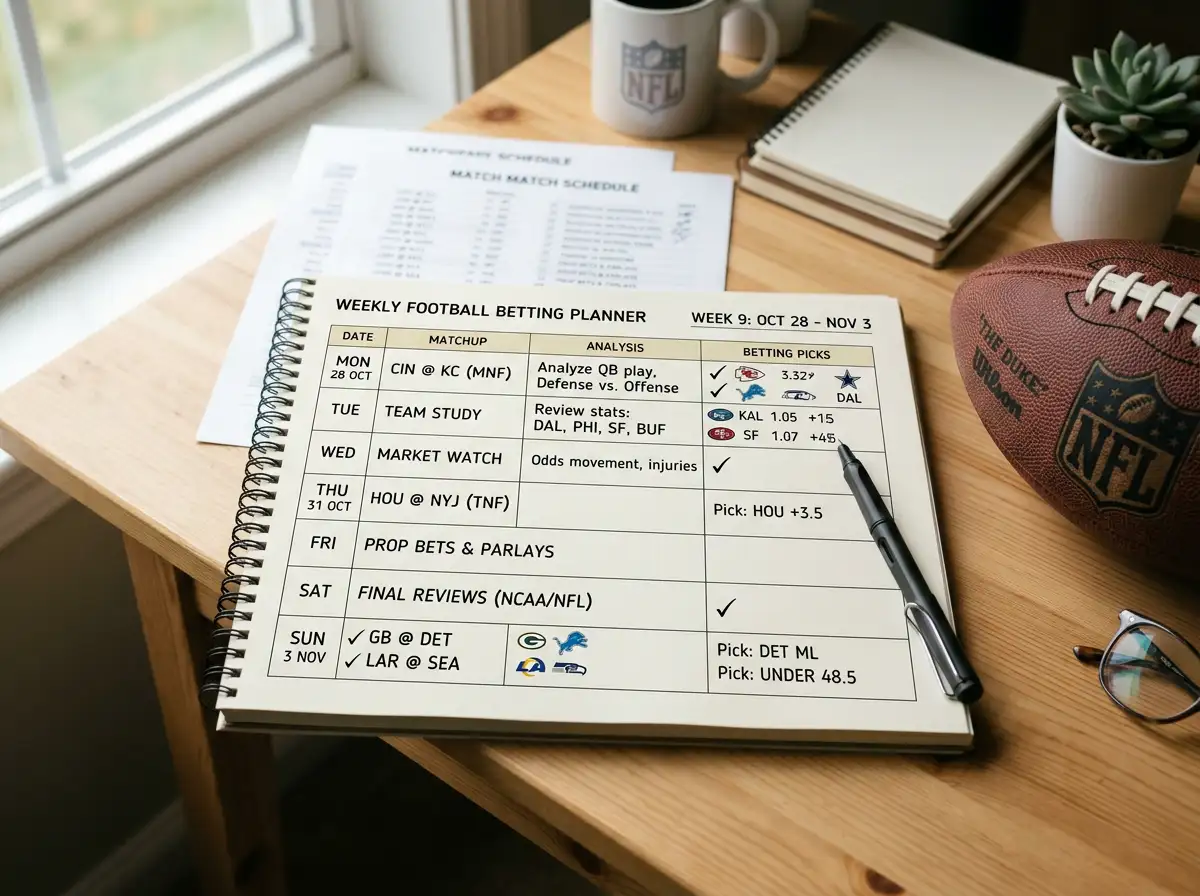
Your original rationale check. Re-read whatever notes or reasoning you recorded when you formed your initial view. Has anything changed materially? If the answer is no — injury report unchanged, line movement consistent with your thesis, weather not a factor — proceed with confidence. If two or three inputs have changed, reconsider the position rather than backing the original analysis purely out of inertia.
How Game-Day Line Movement Signals Sharp Action
Line movement in the final twelve hours before an NFL kickoff is qualitatively different from mid-week movement. Mid-week movement is primarily driven by initial public betting volume and early sharp positioning. Game-day movement reflects last-minute sharp action and any injury news that filtered through late.
Reverse line movement is the most analytically significant pattern to look for on game day. This occurs when the line moves against the direction of public money — the favourite’s line shortens despite the public betting heavily on the underdog, or vice versa. It signals that professional bettors are taking the opposite side of public consensus with enough weight to move the market. Industry analysis shows that these reverse-movement situations track closely with the same public-favourite failure rate that drives the broader fade-the-public strategy: teams that receive 65%+ of public stakes but whose line moves against them are covering at even lower rates than heavy-public teams generally.
Steam moves are the other key game-day signal — a rapid, large movement in a short period, typically indicating a coordinated sharp action from a group of professional bettors hitting multiple books simultaneously. A line that moves from -3 to -4.5 in under thirty minutes on a Saturday morning without any corresponding injury news is almost certainly a steam move. Following steam requires speed, so if you spot it in retrospect you’re mainly using it to validate or challenge a position you’re already considering rather than acting on it in real time.
Timing Your NFL Bet: Pre-Game vs Live on Game Day
The choice between placing a bet pre-game and waiting for live opportunities depends on whether you have a view on a specific game-state scenario. Pre-game is appropriate when your analysis is complete, your checklist is clean, and the current price reflects the value you identified. Waiting for live is appropriate when you’ve identified a specific scenario — “if this team scores first and the live total is still above 47, I’ll take the under” — that gives you a more targeted entry point.
Live betting captures roughly 62% of the total online sports betting market globally, reflecting how dominant in-play wagering has become across all sports. For NFL specifically, the most consistent same-day live opportunity I’ve found is the early-drive overreaction pattern — bookmakers adjust live lines dramatically after the opening possession, often more dramatically than the underlying probability shift justifies. A team that scores on their opening drive generates a significant live line adjustment for their opponent, but one possession doesn’t reliably predict the remainder of a 60-minute game. Pre-forming your response to that scenario before kickoff — deciding what price you’d need to take the other side — turns a reactive live bet into a structured pre-planned position.
For building the weekly analytical process that feeds your same-day checklist with well-researched positions, the systematic approach in the NFL betting strategy guide covers the full week-to-game-day workflow.
When do NFL final injury reports come out before kickoff?
For Sunday games, the final official injury report is released on Friday with a Saturday morning update available for late-breaking changes. The injury designations (out, doubtful, questionable, probable) are confirmed no later than four hours before kickoff for most games. Thursday Night Football injury designations follow a compressed schedule — check on Thursday morning rather than the standard Friday-Saturday cycle. Monday Night Football follows the same Friday-Saturday timeline as Sunday games.
Should I wait until game time to place NFL bets in the UK?
For pre-game positions, placing on Saturday morning for Sunday games is generally optimal — you have final injury information and can observe the previous 24 hours of line movement, but the market is still liquid enough to get your full stake on at the price you want. Waiting until the final hour before kickoff risks getting a worse price if late sharp action has moved the line. For live positions where you’ve pre-identified a specific entry scenario, waiting until that scenario materialises is entirely rational regardless of timing.
Written by the editors at nfl top Bets.