NFL Best Bets This Week UK: How to Build a Weekly Betting Shortlist
 Available in US
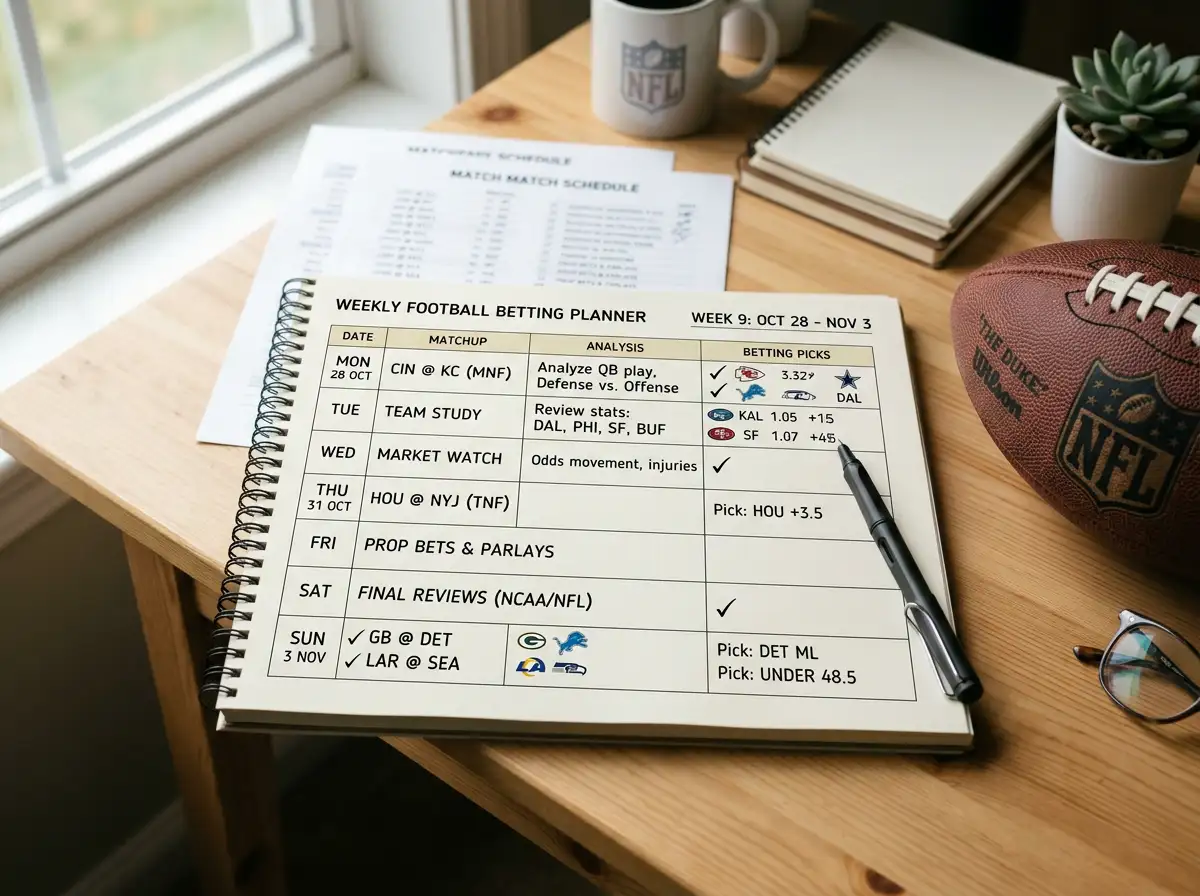
The worst version of weekly NFL betting is browsing the full slate on Sunday morning, picking five or six games that look interesting, and placing bets without any preparation beyond a general sense of which team is better. I’ve done exactly this and it consistently produced my worst results of any season. The best version is the opposite: a systematic mid-week process that produces a shortlist of two or three positions by Friday, with genuine analytical rationale documented for each, ready to execute after the Saturday injury report confirms nothing has changed. The process is what separates a productive week from a reactive one.
Reading the Weekly NFL Schedule for Betting Value
Not all NFL weeks are equal from a betting perspective. Certain scheduling features create structural line-setting challenges that a prepared bettor can exploit — and they appear every week in some form.
Thursday Night Football involves teams playing on a three-day turnaround from Sunday. The compressed schedule creates specific analytical conditions: teams with physicality-dependent schemes (heavy run game, physical defensive line) tend to underperform relative to teams with technique-dependent schemes (quick-passing concepts, zone coverage) because recovery from physical play is more schedule-sensitive. A team whose style depends on winning the line of scrimmage playing a Thursday game after a physical Sunday match-up is analytically worth scrutinising more closely than their overall quality rating suggests.
Short-week rest advantages also apply in reverse — the team not playing on Thursday has a full week of preparation against a team that’s managed two days. Divisional underdogs since 2014 have covered the spread at a 71% rate in opening-week fixtures, and the preparation advantage dimension of that trend applies to Thursday game scheduling dynamics too. The team with more rest almost always has a preparation and recovery advantage that the line doesn’t always fully reflect.
Bye week rest advantage is the clearest scheduling edge. Teams coming off a bye have had fourteen days since their last game — rest, health recovery, extended preparation time. Against a team on a standard week, a post-bye team has measurable advantages in multiple dimensions. Some bookmakers partially account for this in their line-setting; others adjust less than the data suggests is appropriate. Specifically, a post-bye team facing a divisional rival is a combination that historically outperforms expectations at higher rates than either factor alone.
Five Filters for Identifying the Best NFL Bets Each Week
These five filters work as a triage system — you’re not looking for every game where one filter applies, you’re looking for games where multiple filters converge on the same side.
Filter one: public money mismatch. Check which teams are receiving more than 65% of public bets in a given week. This is your starting shortlist of potential fade candidates. Heavy public loading on a team compresses their handicap price and inflates the theoretical value on their opponent. Historical data shows teams with 65%+ public support fail to cover the spread roughly 63% of the time — one of the most reliable repeated patterns in NFL betting across multiple seasons.
Filter two: line movement direction. Is the heavy-public team’s line moving toward them (suggesting the bookmaker is confident public money is wrong and sharp money is on the other side) or away from them (suggesting sharp money is confirming the public view)? Reverse line movement — line moving against the public-money direction — is the strongest single game-week signal for a contrarian position.
Filter three: divisional match-up. Divisional games produce systematic underdog value across multiple seasons of ATS data. If the game involves a divisional underdog, that context elevates its priority in the shortlist regardless of other factors.
Filter four: injury significance. Is there a starting quarterback, offensive left tackle, or primary coverage corner with a meaningful injury status? These are the three most line-sensitive position groups. A genuine uncertainty at any of these three positions — particularly one that emerged late in the week after the line was set — can represent a mispricing worth targeting.
Filter five: schedule context. Is either team coming off a short week (Thursday game), a particularly physical game (measured by sacks allowed, tackles for loss), or entering a game with a confirmed post-bye rest advantage? Schedule context doesn’t override fundamental quality analysis but it can tilt a borderline case from “interesting” to “bet.”
Tracking Your Weekly NFL Results
A weekly tracking format is simpler than a full season record and serves a different purpose. Rather than assessing long-run ROI (which requires a full-season or multi-season sample), weekly tracking answers a tactical question: which of my filters is adding the most analytical value each week?
A useful format: log each weekly bet with the primary filter that drove the selection. After eight weeks, sort by filter. If your “line movement” filter bets are significantly outperforming your “public money mismatch” bets, you’ve identified a real analytical strength worth leaning into. If your “injury significance” bets are underperforming, either the filter isn’t working or you’re applying it inconsistently. This kind of tactical review makes your weekly process self-correcting in a way that a purely results-driven record doesn’t provide.
The key discipline is committing to the shortlist before Sunday morning. Any bet added to your list after 9am UK time on a Sunday game day is reactive betting, not systematic betting — and reactive betting is where the structural advantages of a weekly process get eroded by impulse. Two or three positions built on Wednesday through Friday, confirmed on Saturday, executed on Sunday morning: that’s the process that compounds over a full season.
For the specific pick selection framework that feeds this weekly process most effectively, the guide to making your own NFL picks covers the four-step analytical method in detail.
One structural point about the weekly shortlist that experience has reinforced: the two or three positions you don’t bet matter as much as the ones you do. Discipline is maintained by having a clear reason to not bet a game, not just a clear reason to bet it. If a game passes three filters but fails two others, it doesn’t make the shortlist — and that’s the right call even when it means a week with only one bet. The empty shortlist week is a legitimate outcome of a rigorous process, not a failure of preparation.
How many NFL bets per week is reasonable for a UK punter?
Two to four per week is the appropriate range for anyone betting systematically. The NFL Sunday slate has thirteen or fourteen games, but realistic high-quality analysis can only be done on a fraction of them in a part-time research budget. Two carefully selected positions with documented rationale will outperform six loosely considered ones every time over a full season. If you find yourself regularly identifying six or seven bets per week, apply a tighter filter — only proceed with positions where at least two of the five analytical filters converge.
Do Thursday Night Football games offer different value to Sunday games?
Yes, and specifically in ways that benefit prepared bettors. Thursday games involve compressed preparation and recovery time for both teams, which creates specific line-setting challenges. Teams whose style depends on physical dominance (heavy run games, blitz-heavy defences that rely on fresh legs) tend to underperform their quality rating on short weeks more than teams with technique-and-execution-based schemes. Identifying which team’s style is more schedule-sensitive gives you a genuine analytical angle that standard team quality metrics don’t capture.
Prepared by the nfl top Bets editorial staff.