Switching From Football to NFL Betting: What UK Punters Need to Unlearn
 Available in US

When I started seriously betting on NFL after years of Premier League and Championship betting, I made almost every mistake possible in the first month. Not because NFL is harder to analyse than football — in some ways it’s more tractable — but because I kept applying football betting intuitions to a sport with different structural rules, different market conventions, and different informational dynamics. The unlearning took longer than the learning. If you’re making the same transition, here’s what I wish someone had told me before I placed my first bet.
Five Key Differences Between NFL and Football Betting
These aren’t cosmetic differences. Each one has direct implications for how you analyse markets and where you look for value.
No draws. This is the structural difference that changes everything. NFL games don’t end in draws under normal circumstances — there’s an overtime period, and if overtime doesn’t produce a winner in specific regular-season scenarios, ties occur but they’re extremely rare (roughly once every two to three seasons across the whole league). The practical impact is that the moneyline in NFL is a binary outcome on each team, not a three-way market. The entire Kelly Criterion and expected value mathematics of backing a win changes when you remove the draw probability. A football bettor’s instinct to avoid short-priced favourites partly because of draw risk doesn’t transfer — a 1.40 NFL moneyline favourite has a genuinely higher implied win probability than a 1.40 football home win, because there’s no draw absorbing probability mass.
Handicap dominates over the winner market. In UK football betting, the match result market (1X2) is primary. In NFL, the handicap (spread) is primary — it’s where the most analytical attention, the most liquidity, and the sharpest line-setting resources are concentrated. The NFL winner market (moneyline) is secondary, both in volume and in analytical primacy. Football bettors arriving in NFL often default to moneyline betting because it resembles the match result market they know — but they’re betting in a secondary market that the bookmaker has set less rigorously than the handicap.
Season structure. An NFL regular season is 18 weeks and 17 games per team. The Premier League season is 38 games. This concentration means each NFL game carries proportionally more weight in a team’s season — a single loss changes playoff position calculations dramatically. The motivational stakes per game are higher than in football, which affects how teams approach specific match-ups and has analytical implications for backing teams in “must-win” situations versus teams who are mathematically eliminated from playoff contention.
Bye weeks. Each NFL team has one bye week during the regular season — a week off with no game. A team coming off a bye has had two weeks of preparation and physical recovery rather than one. This creates a specific and documented performance advantage that has no direct equivalent in football’s continuous fixture schedule. Post-bye teams outperform their season-long averages at measurable rates. A football bettor used to thinking about rest only in terms of European fixture congestion has to build bye-week analysis into their NFL approach from the start.
Game pace and clock management. NFL games run approximately three hours with very little continuous play — the ball is in play for roughly eleven to fifteen minutes of actual game time. The rest is stoppages: clock management, huddle time, commercial breaks, reviews. This structural reality means that momentum in NFL — a concept central to football betting psychology — is less continuous and more easily reset than in a sport with near-continuous play. A momentum-driven betting instinct from football often leads NFL bettors to over-weight short-term game state in ways that don’t translate to the American sport’s tactical rhythm.
What Transfers From Football Betting to NFL (and What Does Not)
Home advantage analysis transfers, though the magnitude is different. In NFL, home advantage is worth roughly three points on the handicap — quantifiable and consistent. In football, home advantage varies significantly by league, stadium atmosphere, and travel demands. The transferable skill is understanding that home advantage is a real, measurable factor worth incorporating into analysis. The specific parameters need to be recalibrated for NFL.
Form analysis transfers as a concept but not as a direct application. Recent performance matters in NFL as it does in football, but the sample sizes are dramatically smaller — a team with three games of recent data has played seventeen percent of their season. The weight given to recent form versus longer-term quality assessment needs to adjust significantly. NFL managing director for international markets Gerrit Meier has described the UK as a priority market for NFL’s international growth strategy, and the growing UK audience includes a large proportion of football bettors making exactly this analytical transition.
Injury awareness transfers and is actually more important in NFL than in football. The NFL’s official injury report system — with its three-day designation cycle and standardised probability language — is more structured than anything in football. A football bettor used to monitoring injury news learns quickly that the NFL system gives them a more formally structured version of the same analytical input they already value.
The 1X2 instinct does not transfer. This is the most common mistake. Backing the “draw no bet” equivalent in NFL (a moneyline at decent odds on a moderate favourite) feels analogous to football approaches, but the market structure makes it consistently less valuable than the handicap in NFL for reasons I’ve outlined above. Treating the handicap as your primary analytical market rather than the moneyline — even if it feels less intuitive initially — will accelerate your transition.
How UK Football Punters Should Approach Their First NFL Season
Pick one conference and learn it properly before attempting the full 32-team analysis. The AFC or NFC, with their sixteen teams and eight divisional games per team, is a more manageable analytical scope than the full league for a first season. Deeper knowledge of eight teams produces better picks than shallow knowledge of thirty-two.
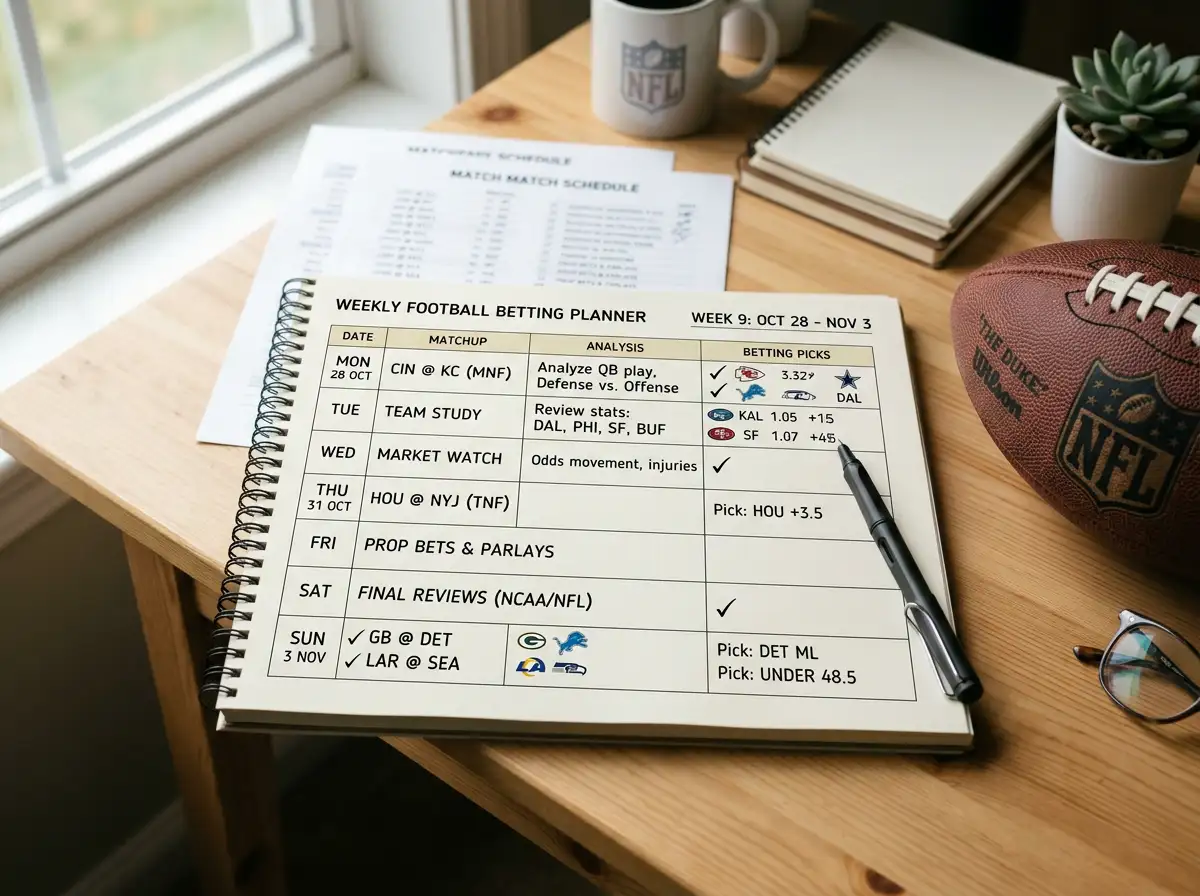
Focus on the handicap market exclusively for your first six to eight weeks. Resist the temptation to explore totals, props, and bet builders until you’ve developed a feel for how handicap lines move, how injury news affects them, and how your assessments compare to the market consensus. The handicap is where the most reliable feedback loop exists for developing analytical accuracy.
For the specific mechanics of how the handicap market works in NFL — the push rules, the key numbers, and the ATS calculation framework — the guide to NFL moneyline betting for UK punters provides the essential market literacy alongside the spread market context.
Is NFL betting harder than football betting for UK punters?
Neither is objectively harder — they require different analytical frameworks rather than different levels of difficulty. NFL has more structured public information (official injury reports, standardised statistics, limited game count per team) that makes certain analytical tasks more tractable than equivalent football analysis. The challenge is unlearning football-specific intuitions that don’t transfer. Most UK football bettors with a rigorous analytical approach find that once they’ve made the structural adjustments to their framework, NFL analysis feels comparable in difficulty to Championship or mid-table Premier League match analysis.
Are NFL odds structured differently to football odds at UK bookmakers?
Yes, significantly. In football, the 1X2 market is standard and offers three outcomes at varying prices. In NFL, the standard market is the two-outcome handicap at near-equal prices (typically 1.90/1.90) with no draw. The moneyline in NFL functions like a two-outcome match result market. The absence of the draw and the dominance of the handicap as the primary market mean that value-finding strategies developed for football 1X2 markets need to be rebuilt from scratch for NFL. The decimal odds format is the same, but the market structure it’s applied to is fundamentally different.
Created by the ”nfl top Bets” editorial team.